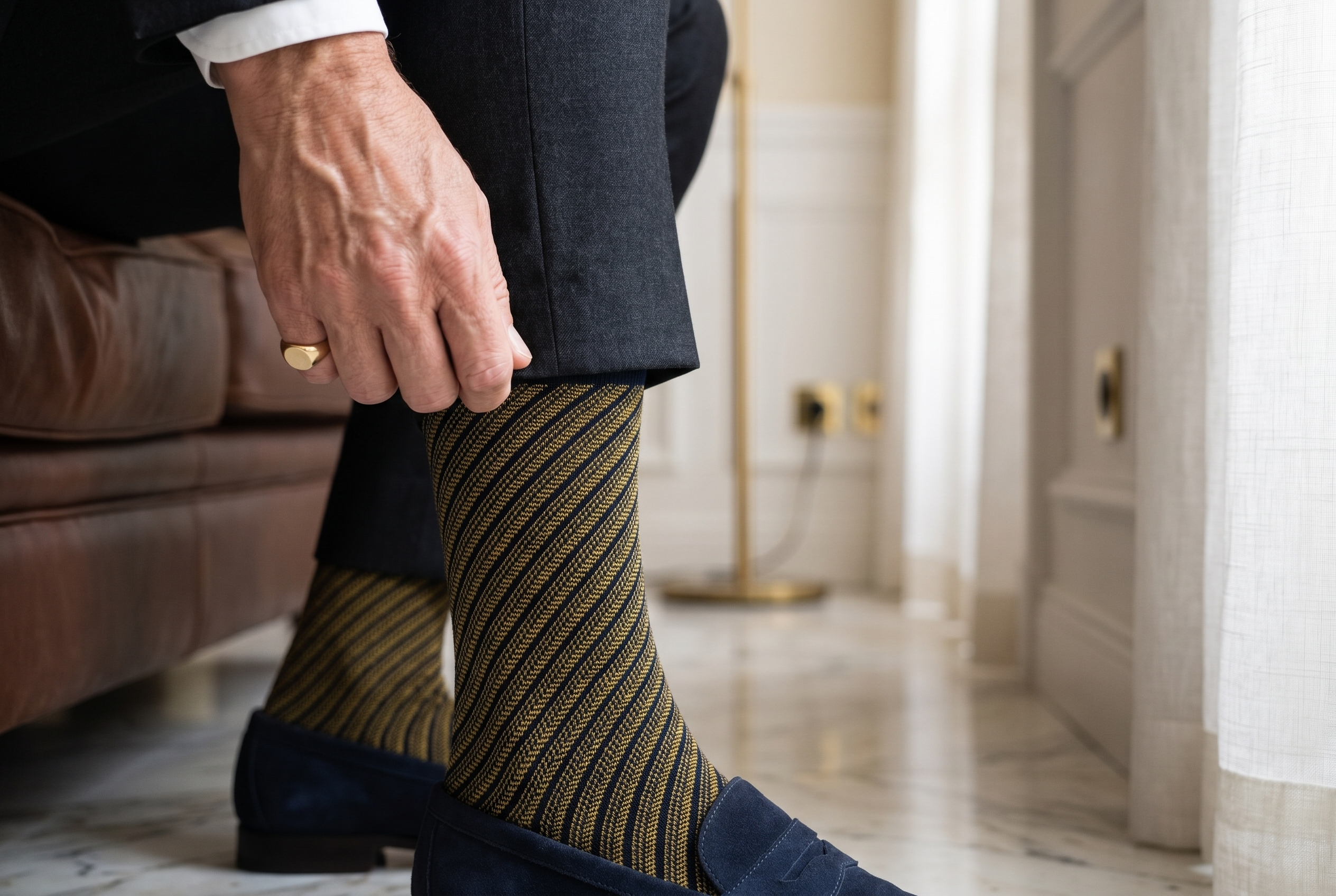
When choosing elegant men's socks, you're not just deciding on color and pattern.
The real difference between a comfortable sock that stays in place all day and one that slips down, squeezes, or leaves marks on your legs depends on two factors:
- the type of cuff (edge)
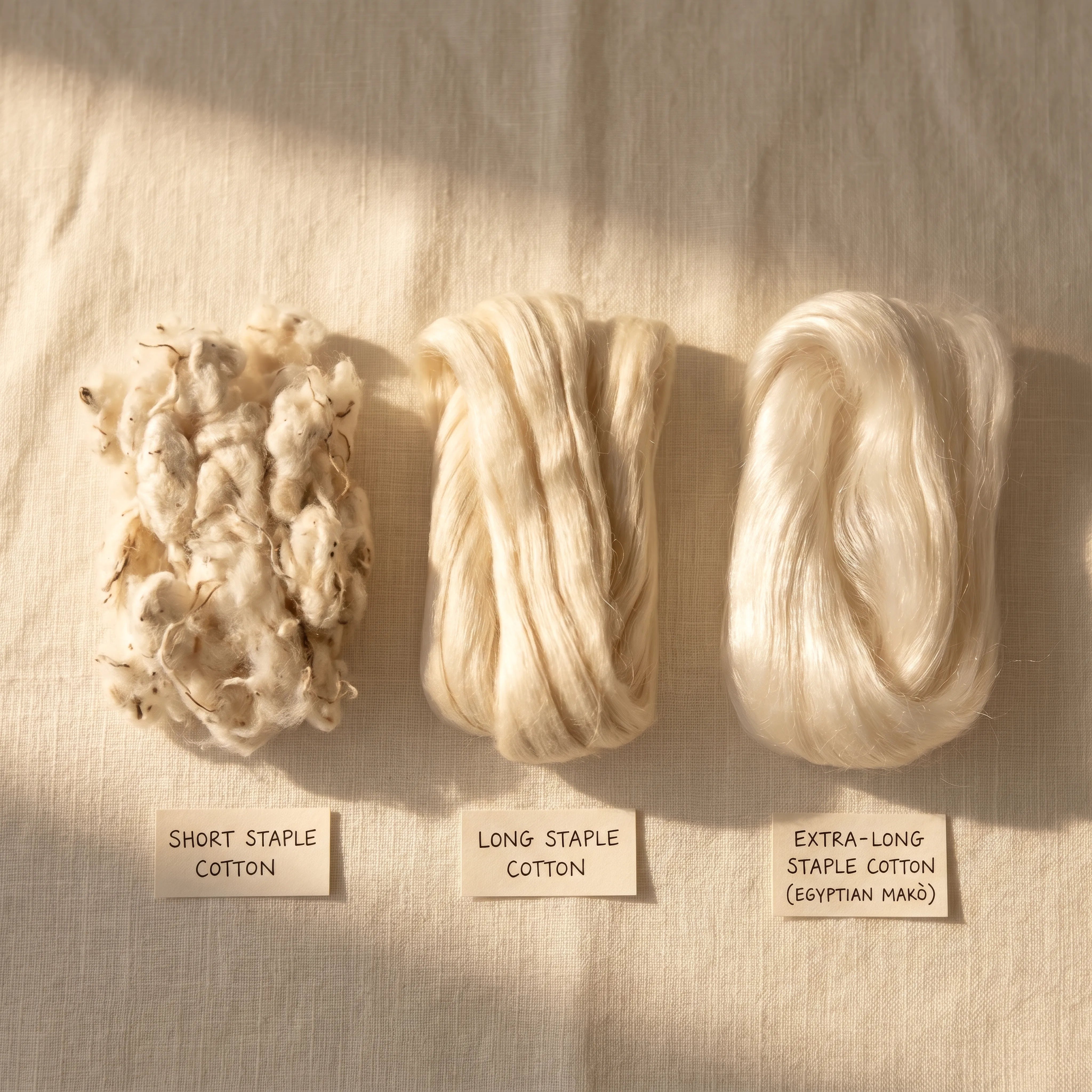
- the quality of cotton
Today the vast majority of socks on the market have a normal edge : an elastic band concentrated in just a few millimetres: this tightens too much or gives way, causing the sock to fall.
Italian Baroque , on the other hand, has always adopted the English cuff combined with Fine cottons , such as long-staple Makò. Our socks also come in a wide range of patterns and colors.
These combinations – almost impossible to find – truly change the experience of wearing the stocking.
What is the English cuff (and why almost no one uses it)
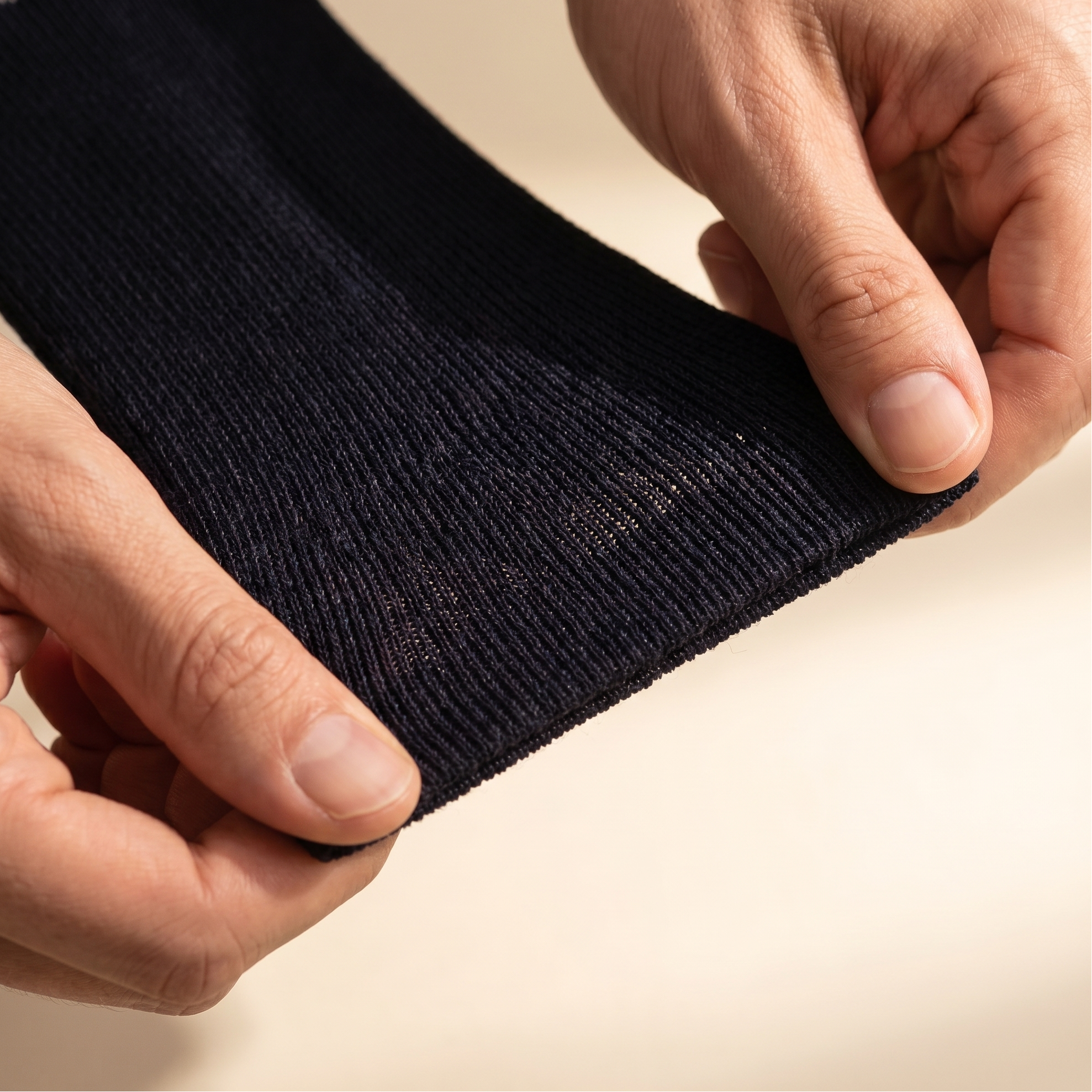
The English cuff it is a particular construction of the edge of the sock:
- it's not just a simple ring of tighter elastic;
- it's a cuff higher , ribbed, which gradually wraps around the calf;
- elasticity is distributed along the entire height of the cuff, rather than concentrated in a single “line” that tightens.
In practice the sock:
- hug the leg,
- not the “size”.
It is a more complex solution to design, produce and regulate.
For this reason, on the market, almost no one takes it as a commitment: it's easier to make a standard edge and push the price.
Barocco Italiano made the opposite choice : instead of following the shortcuts of mass production, it decided to adopt the English cuff as a distinctive sign of its quality socks.
The limits of the normal edge
The socks with normal edge (the classic double edge) always present the same problems:
-
Mark the leg
The elastic is concentrated in just a few millimeters. If it's too tight:- leaves a mark on the calf,
- It creates discomfort and a feeling of constriction, especially at the end of the day.
-
Or it loosens and the sock falls down
If the elastic is softer, it tends to give way after a few hours:- the stocking starts to fall,
- it rolls up on the ankle,
- under elegant trousers the effect is anything but refined.
-
Discomfort on long days
At the office, on the go or at a ceremony, a tight or sagging hem forces you to constantly pull up your stockings.
It's a small gesture, but it's a sign of a sock designed more for cost than for the wearer. -
Reduced duration
The elastic is always concentrated in the same point:- he gets more stressed,
- he gives in first,
- reduces the useful life of the sock.
The concrete advantages of the Italian Baroque English cuff
The Italian Baroque stockings with English cuff They're designed for people who actually use them, all day long.
1. Comfort without marks
- The English cuff wraps the calf evenly.
- The pressure is distributed over a larger area.
- It doesn't leave deep lines on the skin , even after hours.
Perfect if:
- you have sensitive legs,
- you can't stand socks that cut your leg,
- you want to take off your socks at the end of the day without seeing the “grooves”.
2. The sock stays in place
The ribbed structure and the increased height of the cuff allow the sock to:
- fit well to the leg,
- follow the movements,
- stay where it belongs all day long.
Translated: no slipping socks, no rolling up of the ankle, and no constant “fixing.”
3. Perfect fit under dress trousers
With the English cuff:
- the stocking remains taut and tidy;
- it does not create bulges or strange creases under the trousers;
- It accompanies the fabric when you sit down or stand up.
For those who wear tailored suits, office suits or slim trousers , it is a detail that makes the difference between “well dressed” and “really well dressed”.
4. Elasticity that lasts over time
Distributed elasticity:
- put less stress on the single point of the edge,
- keeps the cuff in shape longer,
- guarantees constant hold even after many washes.
An Italian Baroque stocking isn't designed to "last two months and then go": it's designed to truly accompany you.